
























TURÍN
And inmense city





JAVIER MARQUERIE
Turin is Italy’s third most important economic power, the epicenter of the country’s automobile industry (with the headquarters of Fiat, Lancia, Maserati, and Alfa Romeo), and of course, the home of Juventus F.C. This has made the city a household name in Europe, headlining economy newsletters, newspapers, and news broadcasts. However, it can’t be found in any “Italy’s Most Visited Destinations” list. Why? Maybe it’s because of the lack of Roman heritage, a civilization from which only a small archaeological park and the quadrangular layout of its streets – which originated from the distribution of a Roman legion camp – remain.
Maybe it’s because even though it became the capital of Piedmont during the 15th Century, its Renaissance legacy isn’t as vast as Florence or Venice’s. Or maybe it’s because religious tourism has decreased due to the fire that destroyed the chapel where the Holy Shroud was preserved, with the restoration process having taken 21 years from 1997 to 2018 and now being only exposed for special occasions (as well as the scientific doubts on the shroud’s origins).
That being said, Turin is an immense city: immense on its big amount of attractions, history and on its tourist interest area. It is named after the Celtic tribe that lived in the Po Valley, the Taurini, the name of which comes from Tauro, «hill» in the tribe’s language. The Romans founded and named the city Augusta Taurinorum after Roman emperor Augustus.
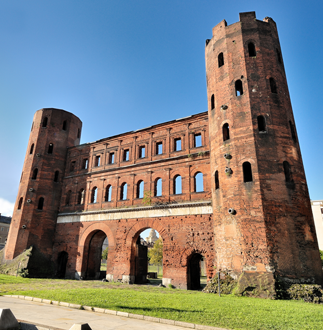
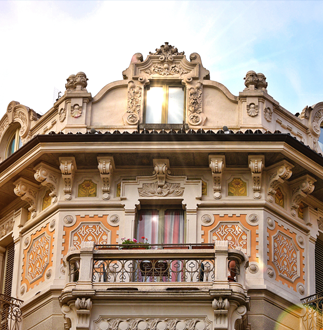
From Roman architecture to 20th century modernist style, Turin’s city landscape is very varied
A dark-bricked castle and the city’s cathedral, among other magnificent buildings, are the remains from the Middle Age and the Renaissance period, but it wasn’t until the 17th Century when the city experienced its golden age, with the Royal House of Savoy establishing their residence and court there and erecting a Royal Palace. This came with a complete remodelling of the city: palaces, churches and squares began to appear all throughout the city. Gigantic buildings with ornate, double column arches – each one more spectacular than the next – serve as the background for this month’s recommended destination. Artists, engineers and architects turned Turin into a city fit for a king, and that’s how we have inhered it today. The city and its historic centre continue to be as live as ever and the presence of tourists doesn’t affect the citizens’ daily life.
As we abandon the city centre, visitors can appreciate the successive first-rate architectural layers: 19th Century neoclassicism, Italian fascist rationalism, and spectacular art noveau. This style was particularly popular in the city, holding a decorative art world expo in 1902 and making an impact only similar to Baroque. This 20th Century aesthetic movement had a curious secondary effect on the city’s façades: the tendency of locals using neon lights to advertise their businesses. These lights, together with the stark yet effective night lighting, serve as an invitation for discovering the city after sunset.
Many things to see
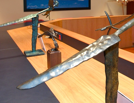
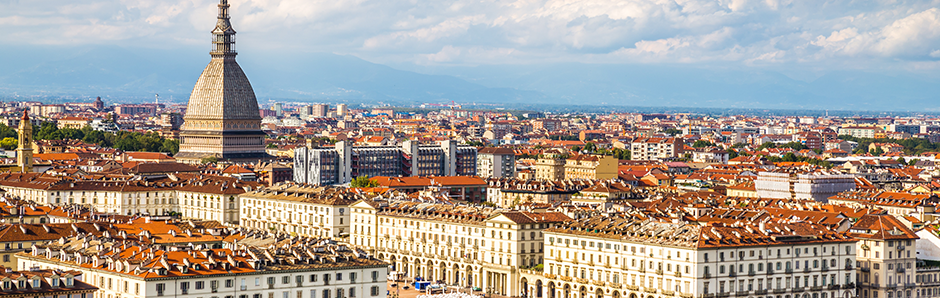
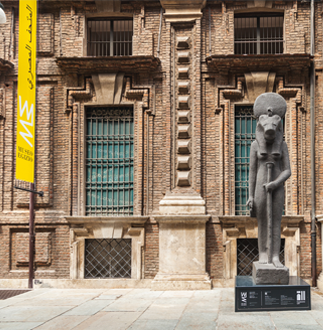
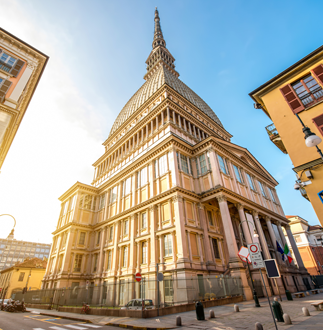
When you arrive in Turin the first thing we encourage you to do is stroll down the Monte dei Cappuccini, a hill overlooking the River Po. From there, you will have a magnificent panoramic view of the city and its two most distinctive landmarks: the Alps, snowed and wild, and the Mole Antonelliana. Whilst the former expand over the skyline, the latter is considered one of the most paradoxical constructions of all time. It is a colossal, 167-metre high dome that covers a building proportionally much smaller. Originally conceived as a synagogue, it is now the home of Italy’s National Museum of Cinema. And speaking of museums, Turin has plenty of them. The Royal Palace is open to the public, with its many rooms showing the monarchy’s well-preserved lavish tastes. There’s also the Armoury, with a collection of armors and swords dating back from the beginning of our times to the 20th Century. Before leaving the palace, you can also visit the chapel where the Holy Shroud used to be exhibited until 1997. Built using black marble in 1667, it was accessed from the palace and from a side stair of the cathedral. But if there’s a museum in Turin worth paying a visit, it is Turin’s Egyptian Museum. Second only to the Cairo Museum, it is proud of housing the second largest collection of Egyptian artifacts, recovered one century ago by Italian archaeologists. Located in an equally amazing building, the collection is exhibited in chronological order and contains some unique objects, including a wide variety of sarcophagi and a couple of wonderfully illustrated books on death found on a non-looted burial ground.
EATING OUT IN TURIN
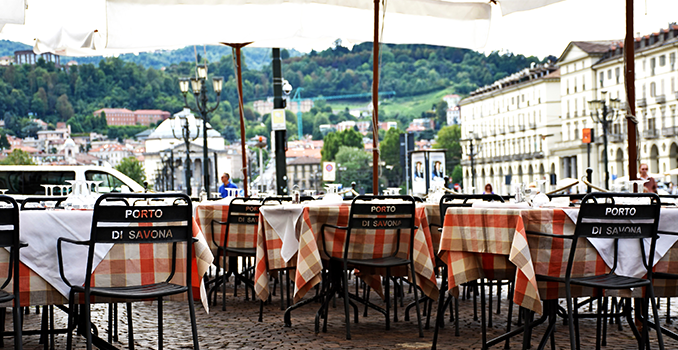
Good news! People from Turin like to eat outside and they like to eat well. Therfore, you can find a wide variety of restaurants and prices, and little to no big fast food restaurant chains can be found in the city. That doesn’t mean there isn’t any fast food around, but it is in the form of fresh pasta (with a wide variety of sauces to choose from), pizza al taglio, or delicious looking sandwiches prepared on small bars and specialised cafes. A gastronomical offering composed of ristorante, osteria, tavola calda, rosticerias, and trattorias.
The latter are quite abundant and interesting, as they offer a cheap daily menu, are very welcoming and there are not many tourists. This is the best way of getting started in the region’s gastronomy. This province produces the best rice in Italy as well as the largest amount of white truffle, so trying a risotto tartufato is a must. The agnolotti (a pasta stuffed with roast meat au jus) is also very traditional. Other delicious gastronomic proposals you can’t skip include the vitello tonato (roast meat with egg sauce, tuna, anchovies and capers), and acciughe al verde: a delicious appetizer consisting of salted anchovies with garlic, oil, vinegar, parsley, chili and bread crumbs.