




























VALENCIA
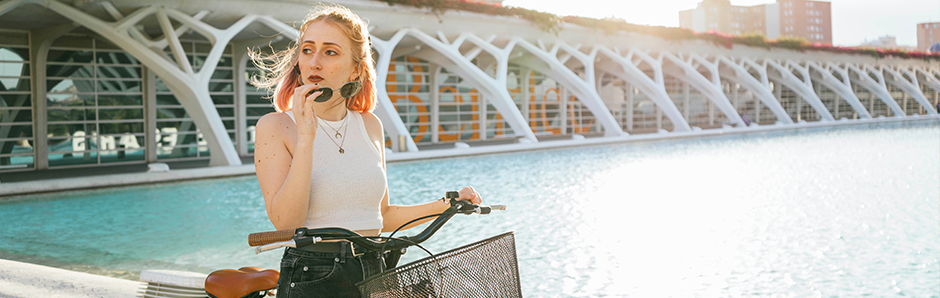
Valencia on a bike? Why not?





Valencia is the third largest Spanish city in terms of population. Located next to the Mediterranean, it is situated in the middle of what is known geographically as the Valencian depression, the Mediterranean basin’s most extensive coastal plain. Valencia is located in the centre of the gulf of the same name, with the Turia River crossing the city from west to east. Owing to this position, it has a mild climate, with little temperature variation and an average temperature of 18.5C
JUAN ZAMORANO
All this makes Valencia a bike-friendly city. Not only is it the right size, with a flat topography and mild climate, but vehicles are limited to 30km/h within its historic centre.
Valencia is part of the Pro-Bike City Network, has a 156km bikeway connecting its different quarters and is home to Spain’s biggest city park in the form of the Turia Park: a 110ha, 8km-long garden that divides the city into two: a family-friendly, cycle tourist attraction.
Successive local governments have been aware of this potential and so, in 2015, the Valencian Municipal Biking Agency – a public body the task of which is to promote biking in a safe manner in Valencia and its surrounding areas – was founded.
Thanks to various means of public transport (bike + underground, bike + bus, bike + train), tourists can get to know the cultural heritage of the city’s surrounding areas such as the Albufera, the Saler Natural Park, the Valencian orchards, archaeological sites such as Horta Vella’s Roman baths or the Turia Fluvial Park, among others.
To top it all, Google Maps also shows bikeways and biking streets: you really have no excuse!
HOW TO GET A BIKE
Bikes can be rented on an hourly or daily basis from a wide variety of companies, while many hotels also offer a bike rental service. For those planning to follow a long route or just looking for easy riding, electric bikes are also very common.
Valenbisi is Valencia’s public bike- renting service and charges very reasonable prices. There are over 300 Valenbisi stations scattered throughout the city. A weekly rental option is also offered and credit card payment is available.
WHERE TO RIDE
Ride your bike on bikeways, bike streets and in the Turia River Garden. Riding a bike on the pavement is not allowed.
A helmet is mandatory on interurban routes (and on urban routes for children under the age of 16). It is not permissible to lock a bike to a tree.
Bike routes in Valencia
TURIA RIVER GARDEN
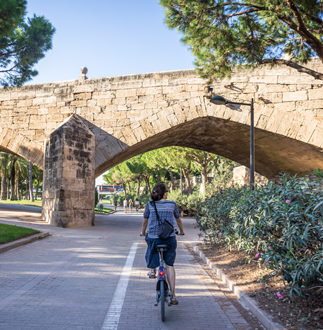
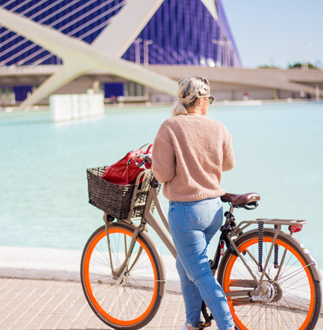
Valencia’s Central Park was conceived after a devastating flood in 1957. After creating a new channel for the river in 1969, the city inhabitants decided the old riverbed should become a park. 13 years later, the Jardín del Turia was officially inaugurated. Over the years, architects such as Ricardo Bofill, Santiago Calatrava and the “Vetges Tú-Mediterrania” team have modified the appearance of the park.
The park starts in the City of Arts and Sciences (which includes the Oceanogràfic, the Hemisfèric, the Príncipe Felipe Museum, the Àgora and the Palau de les Arts), continues past the Palau de la Música and finishes at the Bioparc (one of Spain’s biggest zoos) and the Cabecera Park. These are all popular tourist attractions. Valencia’s green backbone also features many bridges, thousands of plants species, ponds and children’s playgrounds. Thus the park is a family- friendly attraction which connects different locations in the city including the Viveros Gardens, the Fine Arts Museum, the Torres de Serranos and the city centre. Biking around the Jardín del Turia is easy and safe, with many restaurants, activities, and public restrooms located along its 8km.
HISTORIC CENTRE
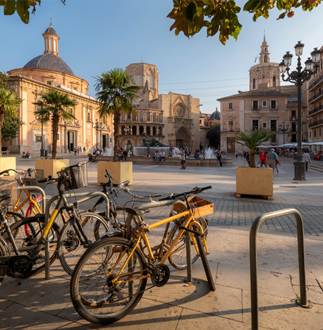
This route – also called the Orange Ring – is a great way of getting to know the city centre. We suggest two starting points. You might begin your route at the Turia Park, then cross the Torres de Serrano and enter the pedestrianised city centre. The other possibility is to start your tour at the Estación del Norte (located next to the bullfight arena), and then ride to the Plaza del Ayuntamiento. Other tourist attractions such as the Micalet, the Palau de la Generalitat, the Plaza Redonda, the Lonja and the Central Market are just a few minutes away by bike. This route combines both bikeways and pedestrian streets. In the latter, you must get off your bikes and walk – but who can be in a hurry when surrounded by so much beauty? We also suggest you take a lock with you so you can park your bike and visit different tourist attractions or have an appetizer at the Central Market or at one of the many bars in the area. There are bike parking spaces located right across the city centre.
EL SALER AND LA ALBUFERA
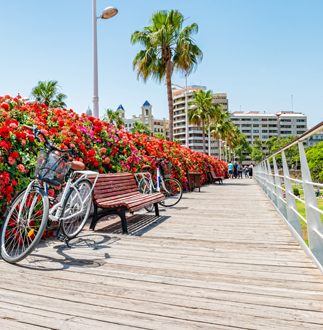
This is one of the most popular bike routes in Valencia. It crosses the Saler Natural Park, the Albufera lagoon and the town of El Palmar. Like many other bike routes in the city, it starts at the Turia Park near the City of Art and Sciences. From there, you follow the bikeway that goes to Pinedo and its beaches. With the sea to your left, you will arrive at the Saler Natural Park with its pines and dunes: a popular picnic spot with a lake and the famous Casa del Bous. The park offers several bird- and plant-spotting routes (you will have to get off your bike for these). If it has rained recently, there will be temporary lagoons surrounding the wooden walkways. If you continue farther on this route, you will arrive at the Albufera, one of Valencia’s most popular locations where the sunsets are simply breathtaking. Leaving the bikeway and joining the road (surrounded by pine trees and rice fields) will take you to El Palmar, a beautiful tourist town located on an island in the middle of the Albufera lagoon. It offers a wide gastronomical offer based on its local product, eels.
MALVARROSA BEACH
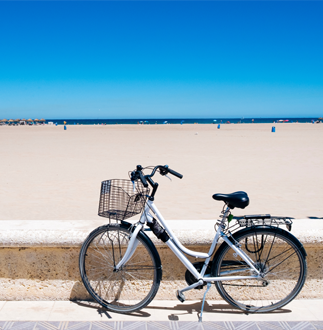
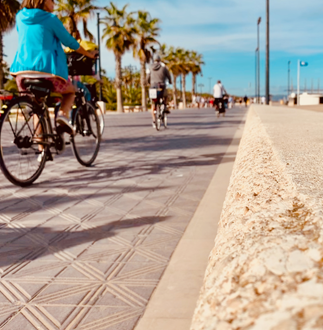
Valencia’s northern façade is composed of a long promenade that runs across the city’s magnificent, always-busy beaches: Las Arenas, Malvarrosa and Patacona. To get here, you will pass through the Cabanyal, the old fishermen’s quarter, with beautiful early 20th century houses. This is one of the trendiest quarters in the city, with many restaurants and a local market where it is impossible to resist buying something – especially fish and seafood. We recommend that you start this route from the port, visiting the old America’s Cup facilities,and continuing until reaching the coast at Alboraya, a town a short distance outside Valencia. This will take you to a unique location: the Ermita dels Peixets. From here, you can head on to your next route, (the Via Xurra, in the west or continue north to Port Saplaya, with its canals, restaurants and a marina.
VIA XURRA
This green route was created after the closure of the old narrow-gauge railway which connected Valencia to Sagunto.
It will introduce visitors to the Horta Nord, a series of small villages with irrigated orchards which produce up to three harvests per year. While you ride your bike surrounded by century-old Arabian canals, you will come across Alboraya, home to Valencia’s signature drink: the horchata, a sweet tiger nut juice. If you continue travelling through the orange trees, you will arrive at the Real Monasterio del Puig. This monastery was built by king Jaume I to celebrate the conquest of the city. The route will end at Puçol, where you can catch a train back to the city.